See Moira Allen's recent video interview on pet loss!
How Soon Should You Get a New Pet?
by Moira Anderson Allen, M.Ed.
When your pet dies, how soon should you get a new one?
Until recently, the standard answer has been "right away!"
That may not always be the best advice, however: Obtaining a
new pet before you have had time to work through your grief can
cause problems for both you and the pet.
So when is the right time? There is no single answer to that
question, because everyone experiences grief in their own way.
For some, the loneliness of an empty house makes grieving more
difficult, and a new pet can help the process. Others, however,
may feel resentful toward a pet obtained too soon.
The time to obtain a new pet is when you have worked through
your grief sufficiently to be confident that you can look forward
to new relationships, rather than backward at your loss.
For some people, that might be a matter of days or weeks; for
others, it might be months or years. Regardless of when you choose
to obtain a new pet, however, the following suggestions can help
you ease the transition and make the new relationship more rewarding
for you, your family, and the pet.
Ten Tips on Choosing a New Pet
- Don't make a hasty decision. Give yourself time to
think. Don't let anyone rush you into a decision or pressure
you into making a choice that isn't right for you. (If it isn't
right for you, it won't be right for the pet either!) Also, don't
let a well-meaning friend or relative force the decision on you
by getting you a new pet before you are ready.
- Don't think of the new pet as a "replacement"
for your previous pet. You don't replace relationships; you build
new ones. Your new pet will be a companion with whom you build
an entirely new set of memories and experiences.
- Do look for a pet that is in some way different from
your previous pet. If possible, select a different breed or sex.
Avoid obtaining a "lookalike" pet, because if your
new pet looks like your previous pet, it is easy to be disappointed
when it doesn't act like that pet. Consider a pet with different
colorings or markings from your previous pet.
- Do research your choice carefully. Shelters are deluged
with pets who were selected unwisely and subsequently "dumped."
Make certain the breed, size, sex, behavior, and needs of your
new pet are appropriate for your lifestyle. Avoid the temptation
to adopt the first animal you see to "fill the void."
- Do involve all family members in the decision to obtain
a new pet. In particular, consider the needs and feelings of
your children. Children build strong attachments to pets, and
may feel that giving their love to a new pet is "disloyal"
to the previous pet. Make certain all members of the family have
had a chance to work through their individual grieving process.
Involve everyone in discussions of what sort of pet to obtain.
If possible, let your children help you select a new pet.
- Don't give your new pet the same name (or nickname)
as your previous pet.
- Don't expect your new pet to be just like the one
you lost. Don't expect the new pet to do the same things your
previous pet did, respond in the same ways, or have the same
characteristics. Instead, enjoy your new pet's individual behaviors,
responses, and characteristics as they develop.
- Don't compare your new pet to your previous pet. After
many happy years with an animal companion, it is easy to forget
that, when it was a puppy or kitten, it, too, was destructive,
disobedient, noisy, or unhousetrained. Your new pet will soon
grow out of its "difficult" phase.
- Do consider the needs of your surviving pets. Will
they welcome or resent a newcomer? Some pets seem to genuinely
mourn the loss of a companion, and you may find that you need
to introduce a new pet simply to comfort the survivor. Remember,
however, that most cats and dogs are territorial by nature, and
that it will take them time to adapt to a new pet. Once you have
introduced a new pet into the household, make sure your existing
pets receive lots of attention.
- Do consider obtaining a new pet before the
loss of your previous pet. If your pet is growing old, or is
ill, consider introducing a new pet into your home now. In many
cases, the presence of a young and active pet has revitalized
an older animal. More importantly, this avoids the problem of
attempting to build a relationship with a new pet while you are
still grieving for the previous pet.
Some additional considerations:
If your pet died of a contagious illness, make certain your
home is thoroughly cleaned before a new pet is brought in. Dispose
of items that might carry the illness, such as bedding, rugs,
or toys.
Give some thought to the disposition of your pet's belongings.
Some people enjoy passing a pet's things to a new pet; others,
however, feel that such items should not be transferred. If you
prefer to dispose of your pet's possessions, consider whether
a shelter might benefit from those that are in good condition.
If you're not certain whether you're ready for a new pet,
but you need to cuddle something furry and warm, consider volunteering
as a "pet cuddler" or even a foster parent to help
socialize adoptable animals at your local shelter. You'll be
able to give love and receive comfort without making a commitment.
And who knows? You may discover the perfect companion to share
your life!
When a pet dies, grief is a normal and natural response. Never
let anyone tell you that you are crazy or silly to grieve over
"just an animal." The loss of a relationship brings
pain-so do what you need to do to work through that pain. Cry,
grieve, pound a pillow, talk to a friend or support group, conduct
a memorial service that will help you pay tribute to your pet
while saying good-bye. Then, when the time is right for you,
you'll be able to share your love with a new, well-chosen animal
companion.
Copyright © 2001 by Moira Allen.
| Please visit our Handouts and Reprints page for information on distributing this information as a brochure or text handout. |
When a pet dies, you want help... fast!
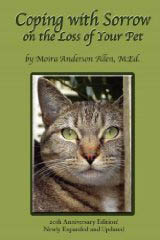
You'll find it in Moira Allen's Coping with Sorrow on the Loss of Your Pet. In a book filled with comfort, compassion and support, you'll find the tools and tips you need to:
 |
- Understand the feelings you're going through -- and find ways to ease the pain
- "Say good-bye" with memorials, tributes and other coping strategies
- Help your children and other family members deal with their grief
- Deal with people who "just don't understand"
- Help surviving pets cope with the loss of a missing companion
- Come to terms with the guilt we so often feel when a pet dies
- Handle the agonizing decision of euthanasia
- Choose the best and most comforting "final resting place" for your pet
- Determine when and how to bring a new companion into your home (how soon is too soon?)
- Improve your chances of recovering a lost or stolen pet
- Help a friend cope with loss
|
Coping with Sorrow on the Loss of Your Pet celebrates over 30 years in print -
our expanded Third Edition is available from Amazon.com in Print and Kindle editions!*
*(Please note that these are affiliate links. As an Amazon Associate I earn from qualifying purchases.)
Quantity discounts are also available; please visit our Quantity Orders page for details.
|

 HOME ·
HANDOUTS ·
Links ·
Pet Loss Hotlines ·
List Your Organization ·
List Your Product
HOME ·
HANDOUTS ·
Links ·
Pet Loss Hotlines ·
List Your Organization ·
List Your Product